
Abhishek Menon did his undergraduate studies at University of Maryland where he did research in the group of Chris Monroe. He is now joining our trapped-ion effort at Rice. Welcome Abhi!

Abhishek Menon did his undergraduate studies at University of Maryland where he did research in the group of Chris Monroe. He is now joining our trapped-ion effort at Rice. Welcome Abhi!

Roman Zhuravel just joined Pagano Research group in July 2021 with the prestigious Attwell-Welch Postdoctoral fellowship! He did his PhD at Hebrew University studying electron transfer in DNA and he is ready for a new adventure using trapped ions as a tool for quantum information science. Welcome!

What is a Time Crystal? Is disorder a necessary ingredient to stabilize this new phase of matter that features a robust sub-harmonic time response? In this paper we investigate what are the conditions to observe a prethermal time crystal and its dependence on the frequency drive and the initial state.

If you want to know more about how to use trapped ions for quantum simulation of spin models, you can read this thorough review, that covers both the basics and the most recent results in the field. Enjoy!

Understanding how fast quantum information propagates in a many-body system is of crucial importance from a fundamental point of view as well as for quantum computing applications. Under which conditions a quantum excitation spreads across the entire system or remains confined and thermalizes very slowly? If you want to know the answer, check out our new paper on Nature Physics on domain wall confinement in a trapped-ion quantum simulator!

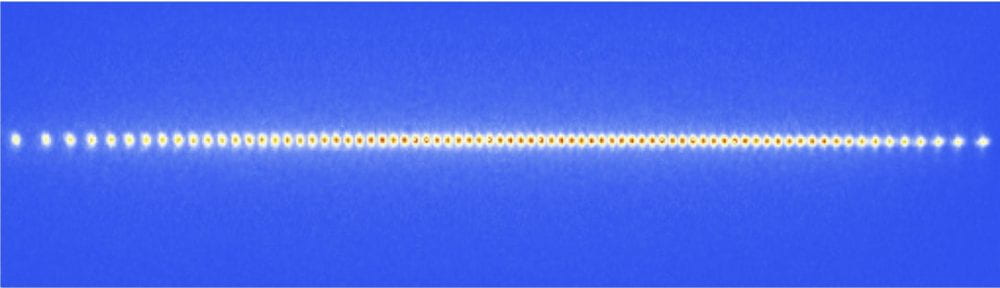
In trapped-ion systems quantum information is processed using normal modes of motion. Cooling down to the absolute ground state these motional degrees of freedom is crucial to enhance gate fidelities and to scale up quantum simulators. In this paper we develop a new EIT cooling scheme that works on ions with a “tripod” atomic structure which have pristine nuclear spin qubits. Check out on Phys. Rev. Lett. how to ground-state cool up to 80 harmonic modes in a 40 ion chain in only 300 µs!

Gauge field theories play a central role in modern physics and are at the heart of the Standard Model of elementary particles and interactions. Check out on the Physical Review Research our detailed proposal on how to simulate high energy physics with a trapped-ion quantum processor!

Quantum devices might be used to solve to solve hard optimization problems. A first step toward this goal has being achieved at University of Maryland, where a joint theory and experimental collaboration led to the experimental realization of the quantum approximate optimization algorithm (QAOA). By using a cryogenic trapped-ion quantum simulator we run the QAOA with up to 40 qubits, the largest realization to date. Check out our paper on PNAS!

We conducted a detailed study designing a reliable scheme for transporting and merging arbitrary pairs of two-electron atoms in optical tweezers to entangle them via optically-gated spin-exchange interactions, leading to a collisional gate scheme that is largely insensitive to beam pointing and intensity fluctuations. Our paper got the front cover of Advanced Quantum Technologies!
We are an experimental research group at the Physics and Astronomy Department at Rice University. We use individual atoms as carriers of information and control precisely their mutual interactions. For more details, please have a look at our research directions!